On Breaking the Spell
We’re starving for shared attention. Deliberate chaos is one way out of our smooth, algorithm-trained world.

On a recent visit to Sarajevo, I crammed in as many plays and regional films as two weeks could hold. The film scene is definitely bubbling in ways that feel newly confident, more willing to be clever, poetic, and uniquely contemporary without defaulting to a wartime narrative. Exciting times ahead! However, what stayed with me the most was a modestly staged play at SARTR1 called Stotinu malih smrti (Hundred Small Deaths), built from the work of Bosnian-American author Semezdin Mehmedinović2.
SARTR, or short for Sarajevski ratni teatar (Sarajevo War Theatre) was founded in May of 1992, in the early months of the siege, as a gathering place for theatre professionals and students who kept making anti-war productions in conditions designed to erase ordinary life. During the war it staged Sklonište (The Shelter) ninety-seven times, a feat that has become part of the city’s cultural mythology. Its founding director, Safet Plakalo3, has described SARTR as Sarajevo’s “spiritual weapon against the surrealism of war.” Today it remains one of the sharpest experimental stages in Bosnia and Herzegovina.
What struck me, sitting there in peacetime Sarajevo, was how little it took to make a whole room move as one. We were seated on the stage amongst the actors, witnessing them unfold a narrative around us, among us, next to us, and with us. Cutting through the space was a broad, slightly raised ring walkway, cranked into motion when the plot needed to shift. The actors stepped onto it and spun past and through us, slipping into other eras, as well as other versions of themselves. We journeyed together through a surreal and borderline chaotic travel through time as different actors played past and present versions of the same character, while the lone female role—played by the indomitable Amila Terzimehić4—glided in and out of multiple, energetically opposite women with unnerving ease. At one point, in a casual breach of the fourth wall, an actor served us coffee, except in the cups was a small piece of paper. And then there was us, the audience, a hundred bodies choosing to pay attention together.
Since seeing this play, I have been struggling to name what exactly resonated. Above all, it did not take much to produce, it wasn’t a spectacle. It was just a good story, with a simple set, and great talent. What made it feel so alive wasn’t polish, but the way the piece kept rearranging our attention. We weren’t watching from a safe distance. We were on the stage, inside the mechanism of the moving ring which cut through the space like a conveyor belt for different realities. Yet none of it was random. It was designed instability, a controlled chaos that refused to give us one clean, unified view. And because everything was so close and so modest, our shared attention also became the medium.
Naomi Klein, writing about surrealists pushing against fascism, describes how the radical artists of the interwar period “met their moment imperfectly…but they did meet it together,” building communities that opposed militarism and fascism not only in theory but through daily practice. Their art exposed “farce and artifice in bourgeois society” and insisted on collectivity as method.
That insistence of togetherness as a method, feels increasingly rare inside the visual regime most of us live in now. Ramdane Touhami refers to it as “visual obesity”: the overconsumption of the same visual modes and codes, a globally uniform style shaped by social media algorithms which are slowly leading us towards a future where we may not be able to create due to being enmeshed within a certain “aesthetic routine”. Touhami argues that this feed of the same forms, over and over, is generating a type of aesthetic boredom, resulting in our inability to envision a longer-term perspective— which is making us all quite unstable and fatalistic.
If the algorithmic feed trains us to consume, deliberate chaos trains us to notice. And this is where I loop back to a performance that would look from a distance like a carnival, but up close maybe one of my favorite examples of breaking the spell of the everyday trance.
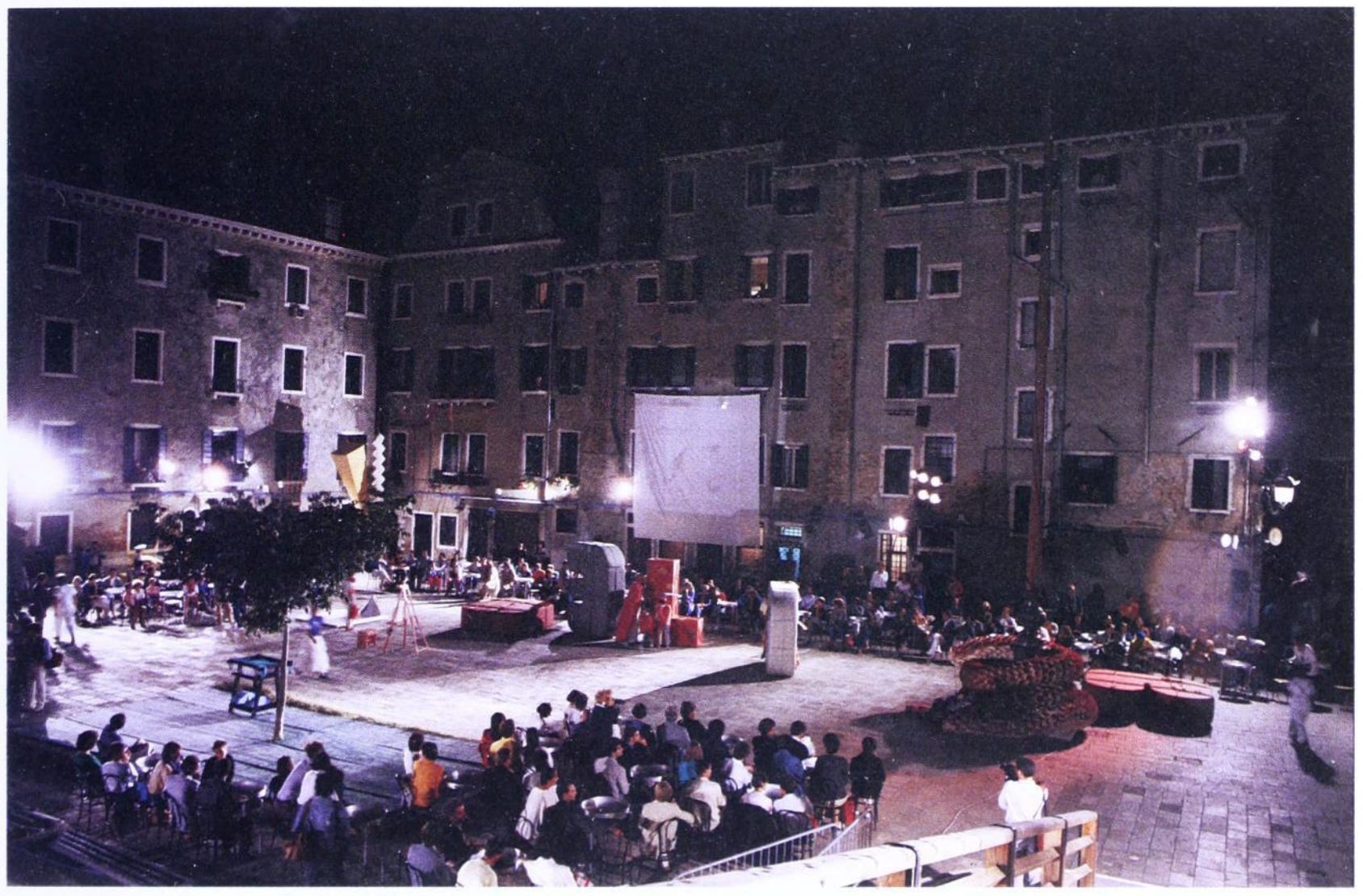
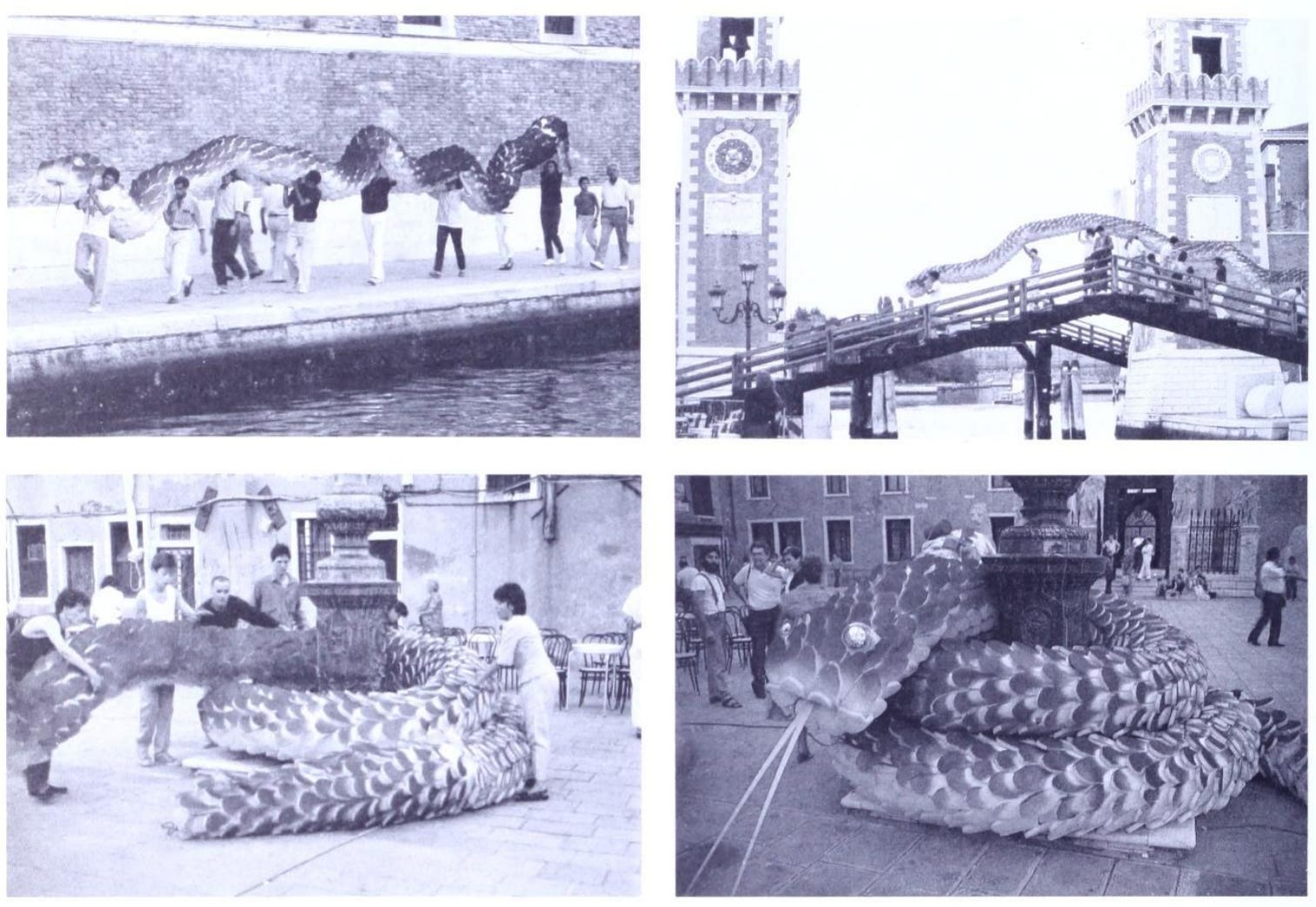
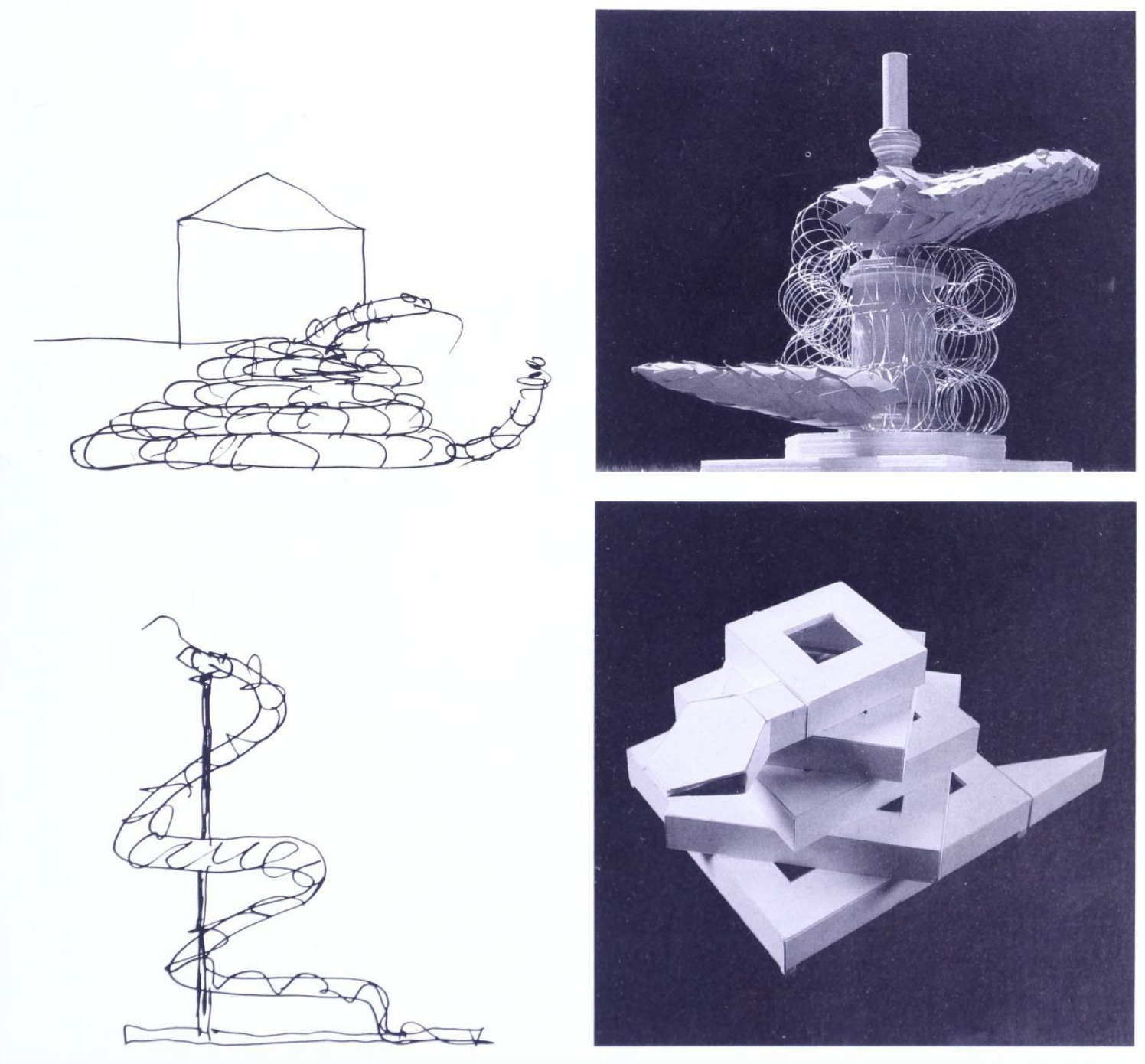
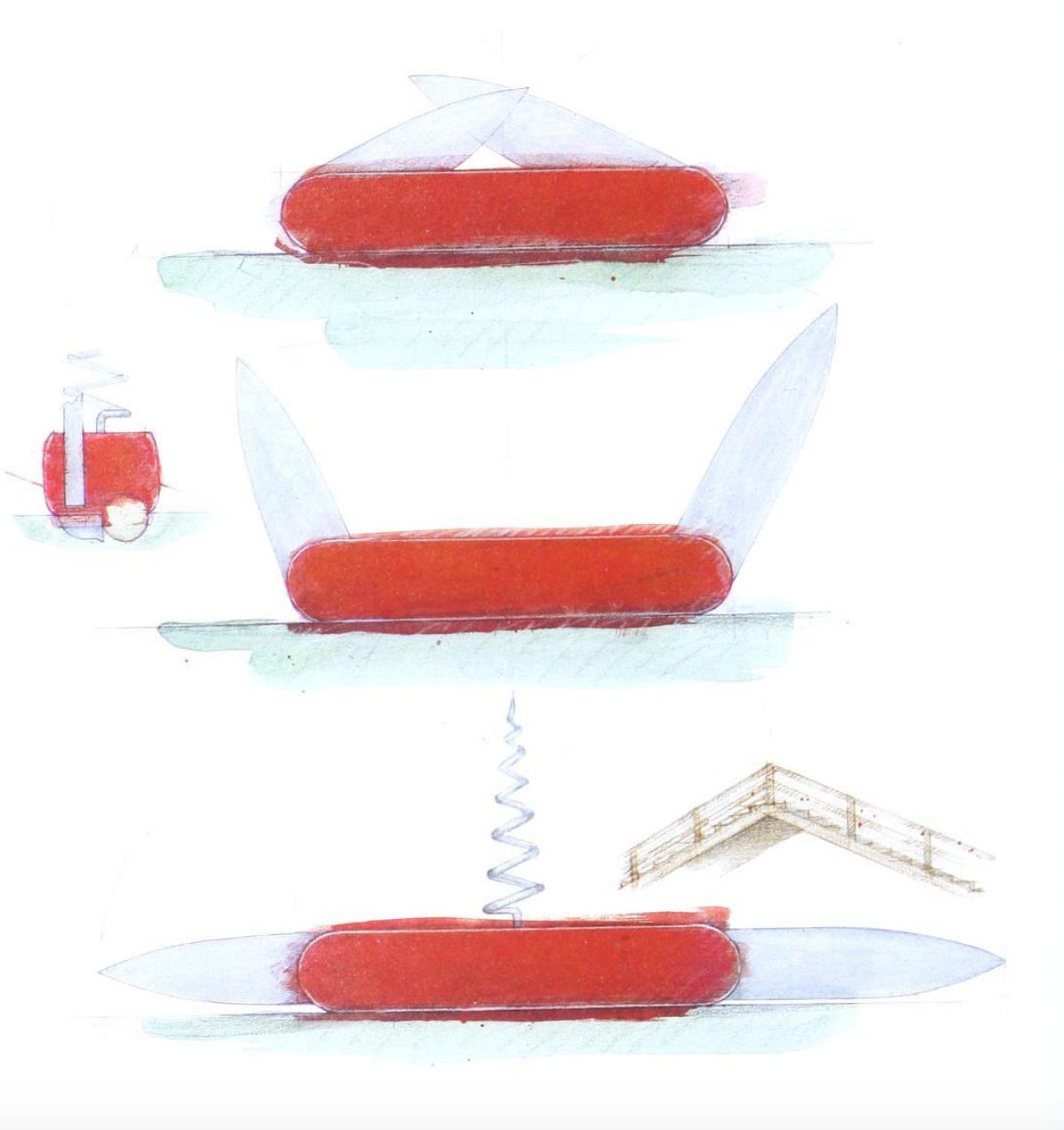
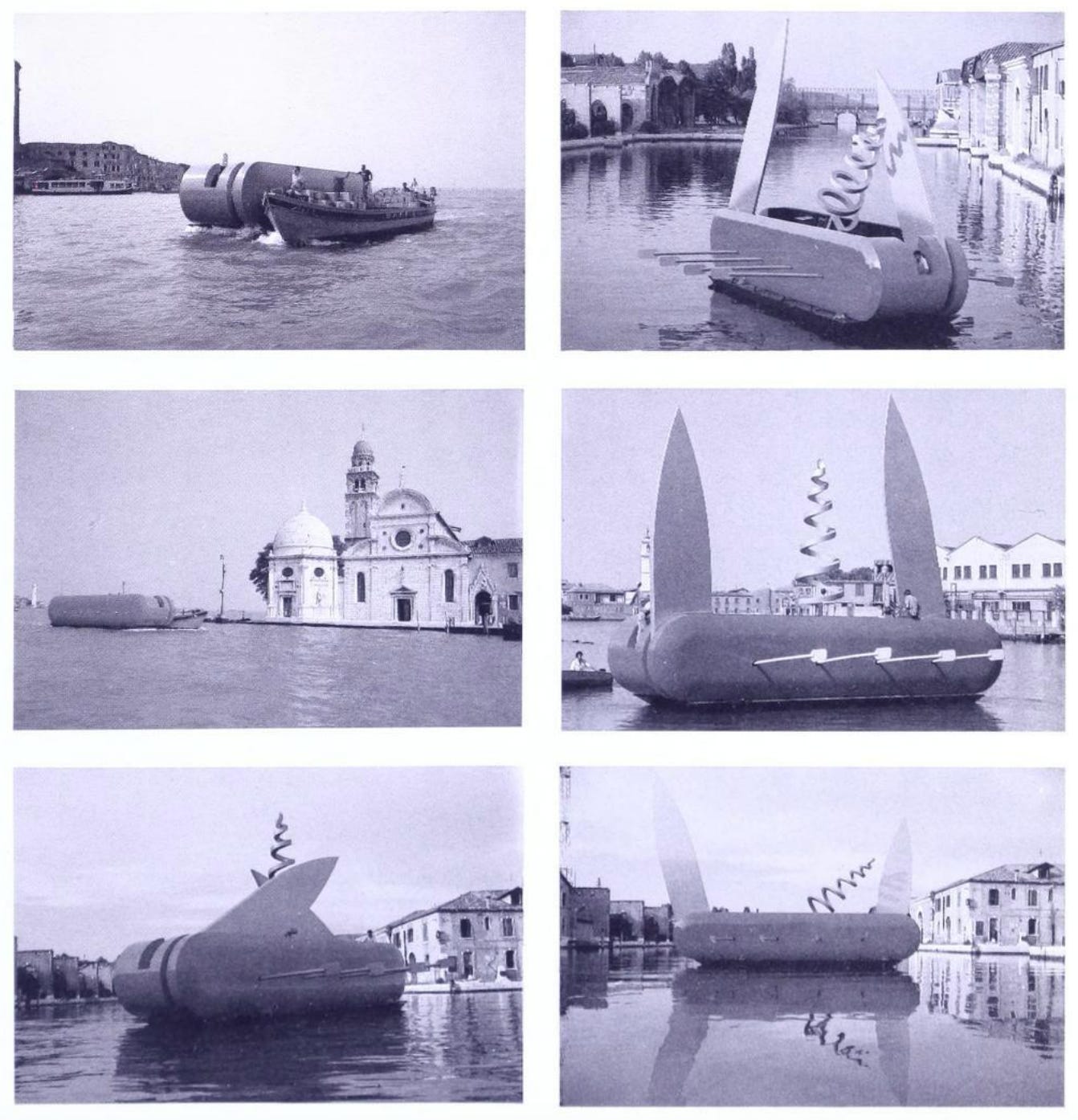
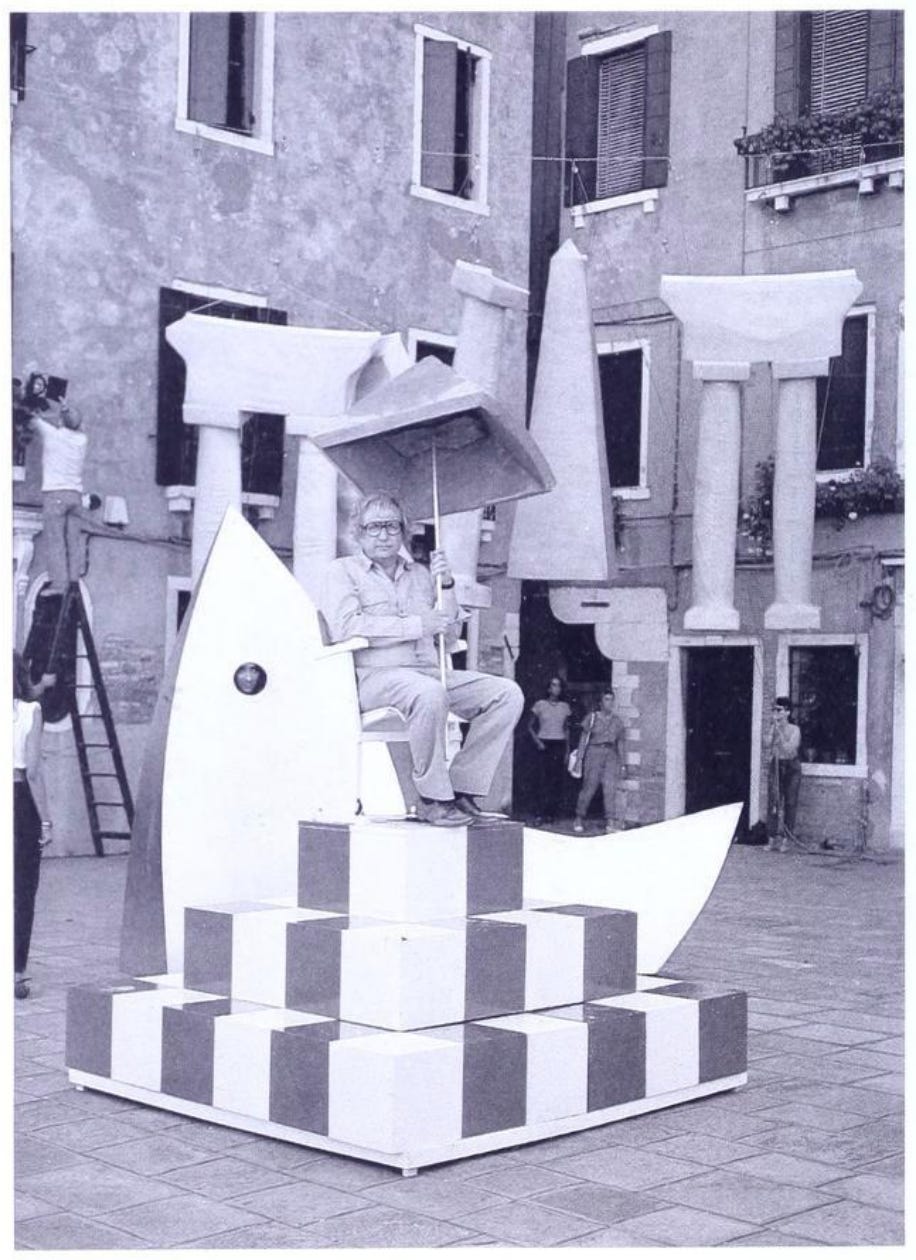
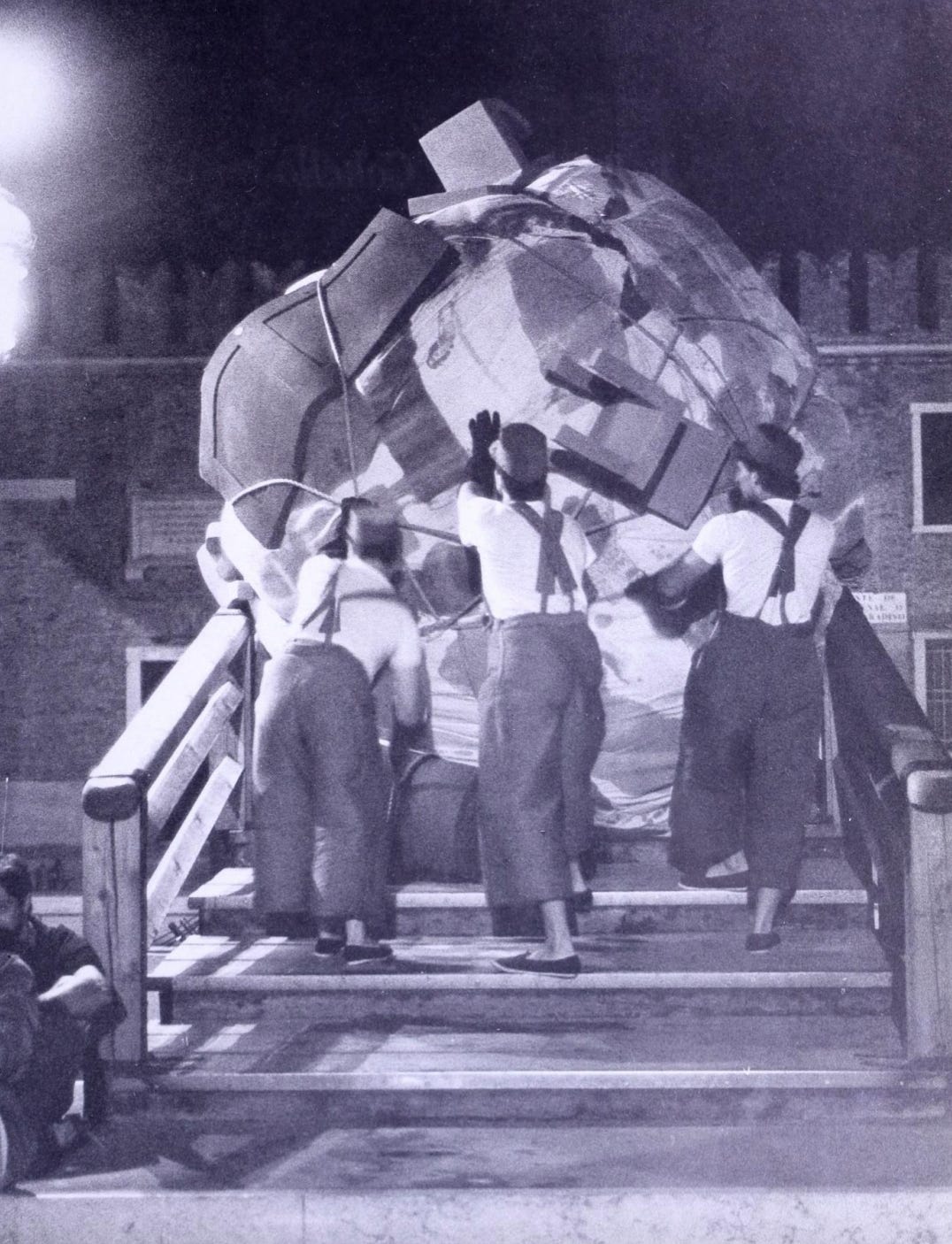
In September 1985, an incredibly surreal and by now mostly forgotten Il Corso del Coltello (The Course of the Knife) was staged three times at Venice’s Arsenale, an ancient shipyard which was still under the Italian Navy control. It was conceived under the provocation of critic Germano Celant and realised by Claes Oldenburg, Coosje van Bruggen, and Frank O. Gehry as an improbable collision of sculpture, theatre, and architecture. Its centrepiece was a monumental Knife Ship, a twenty-four meter long Swiss Army knife set afloat complete with opening blades and a corkscrew.
At the outset, van Bruggen and Oldenburg spent two weeks in Gehry’s Venice office, following his daily routine and absorbing his working method. What clicked was a shared instinct: architecture shouldn’t behave like a neutral container. A building could be an object, something to register immediately, before being able to understand what it’s for. Oldenburg had been doing this for years by enlarging ordinary things until they became architectural in scale and impossible to ignore. Gehry, from another direction, was pushing buildings toward a more bodily, sculptural presence, towards forms that hit you first through sensation, not explanation. For all three, the starting point wasn’t clarity but disruption: take the familiar, knock it off balance, and let new meaning form in the wobble.
The goal with the performance then wasn’t to restore order but to escape the power of a single, monolithic vision. They wanted forms that fall, twist, seethe, whirl, and perspectives to be dislocated and multiple. Not chaos as mess, but chaos as a refusal of the one perfect view. Gehry, for his part, would put it bluntly: Western culture has a fixation on one kind of order of symmetry, classicism, and the central axis. The trio was adamant in breaking that spell.
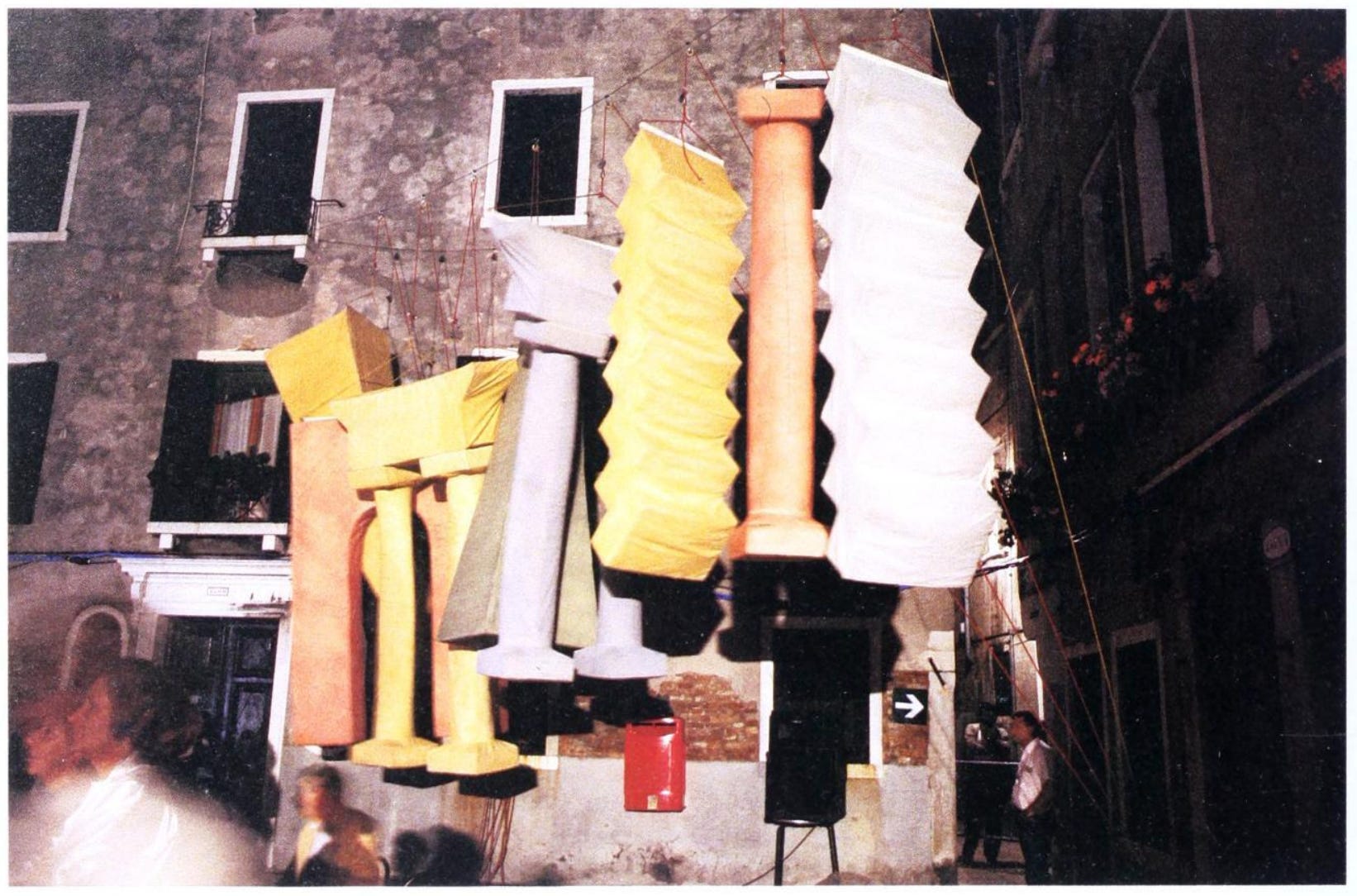
Prior to the performance of Il Corso del Coltello, Oldenburg had a history of what he called Happenings, performance pieces built on simultaneity and equivalence, the exchange of everything with everything else. He often spoke how at the bottom of everything he’d done is the desire “to touch and be touched.” His performances did not come out of ideas or scripts, but often out of materials, from time spent in a place, and from what was available—including people. In Happenings like Injun (1962), Autobodys (1963) and Washed (1965) attention shifted from what was spoken to what was done, from the object itself to its transition. Yet the transitions were never explained, which is why they stayed “strange”. These performances didn’t chase tragedy or big meaning, they stayed close to the everyday, letting ordinary things carry the charge. The props used in Happenings of the 1960s were never meant to survive, and after every performance the debris was sorted out and recycled into props for the next one.
By the time Il Corso del Coltello landed in Venice, the trio wanted to make a “cut” through this established rhetoric of art and architecture, and away from Venice’s commercialized tradition. Venice being so protected, and so commodified, they worried that the work would become yet another polite decoration. They knew they couldn’t change or alter any part of the city, so instead they decided to stage an interruption: a temporary “cut” that left the fabric of the city intact but scrambled how it was experienced. The knife became the symbol of that move, not of violence but incision, breaking the spell of history-as-product so the everyday could feel strange again.
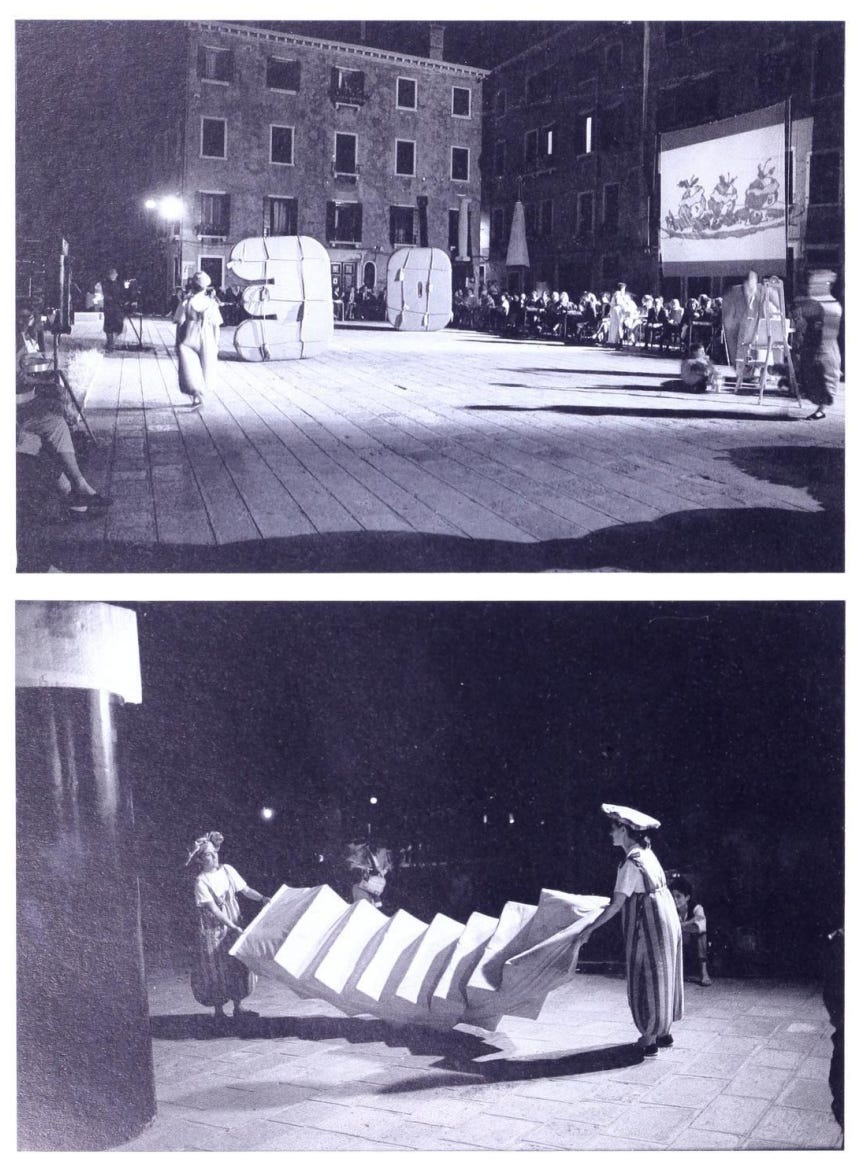
The spectators of the Coltello arrived and were divided into groups of twelve, guided along the Fondamenta by waiters in black costumes with oversized white bow ties. In the open space of the campo they faced a “café”: tables and chairs waiting as if the performance had already begun without them. Seated in groups of six, they were served coloured water, poured into hollowed surfaces built into the tables. Porters in grey rolled oversized letters of the alphabet across a bridge. As Oldenburg treated sound as another object, he had a taped score of voices and noise run against a violinist playing the kind of classical pieces tourists expect to hear in Venice. All this while myriad of other characters moved about, reciting their lines.


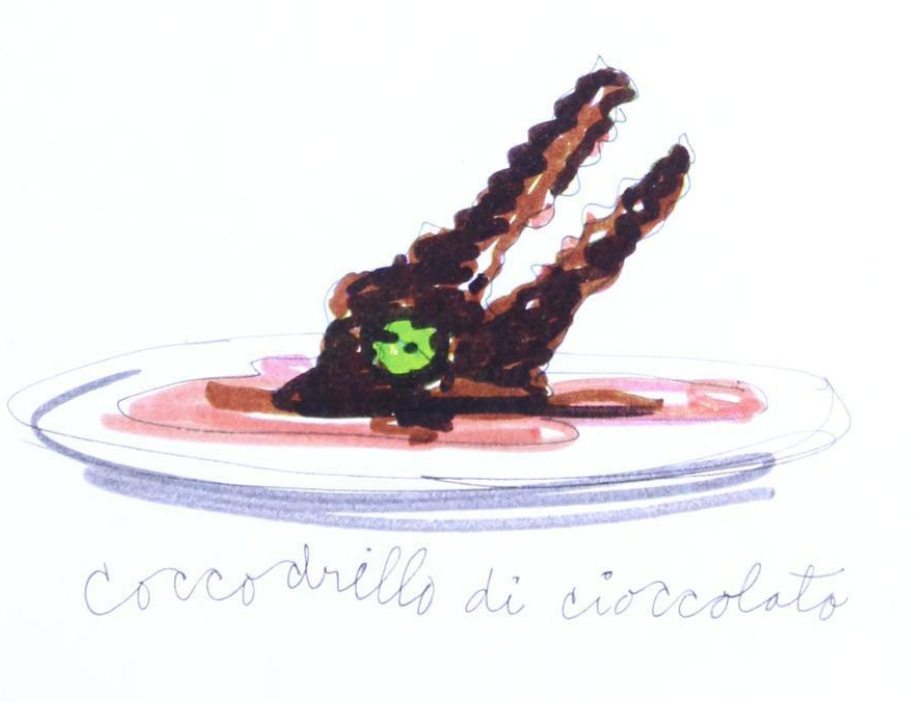
While entrances and exists of characters and objects were scripted, precise actions were not learned by heart but were left to improvisation. Everything worked for a controlled chaos, which Oldenburg, van Bruggen and Gehry used for the transmutation of energy into new forms. Eventually waiters would come out reciting specials of the day, strange dishes like cream of cork soup, or billiard balls with ricotta and sausage. Busboys and girls would then bring cardboard plates imprinted with images of food. The sustenance offered was fiction, with plates floating in the coloured water pools of the tables.
The cafe scene was chaotic in the most intentional way, as if the public has caught the actors and technicians before they were ready. Chairs were out of place, characters appeared nervous. The audience was introduced into an aural, visual, physical, and gestural uncertainty. The performance refused the comfort of a cohesive view, offering instead a pile-up of fragments that kept changing depending on where one sat and when one looked. Once the performance had set its basic machinery in motion: who was who, what was wanted, what might happen—it began to recede. The action thinned, the signals weakened, until the performance grew difficult to see or hear at all, and, as Oldenburg later described the event was, “no more than a tiny star in the distance and the audience are castaways like on the Raft of the Medusa.”
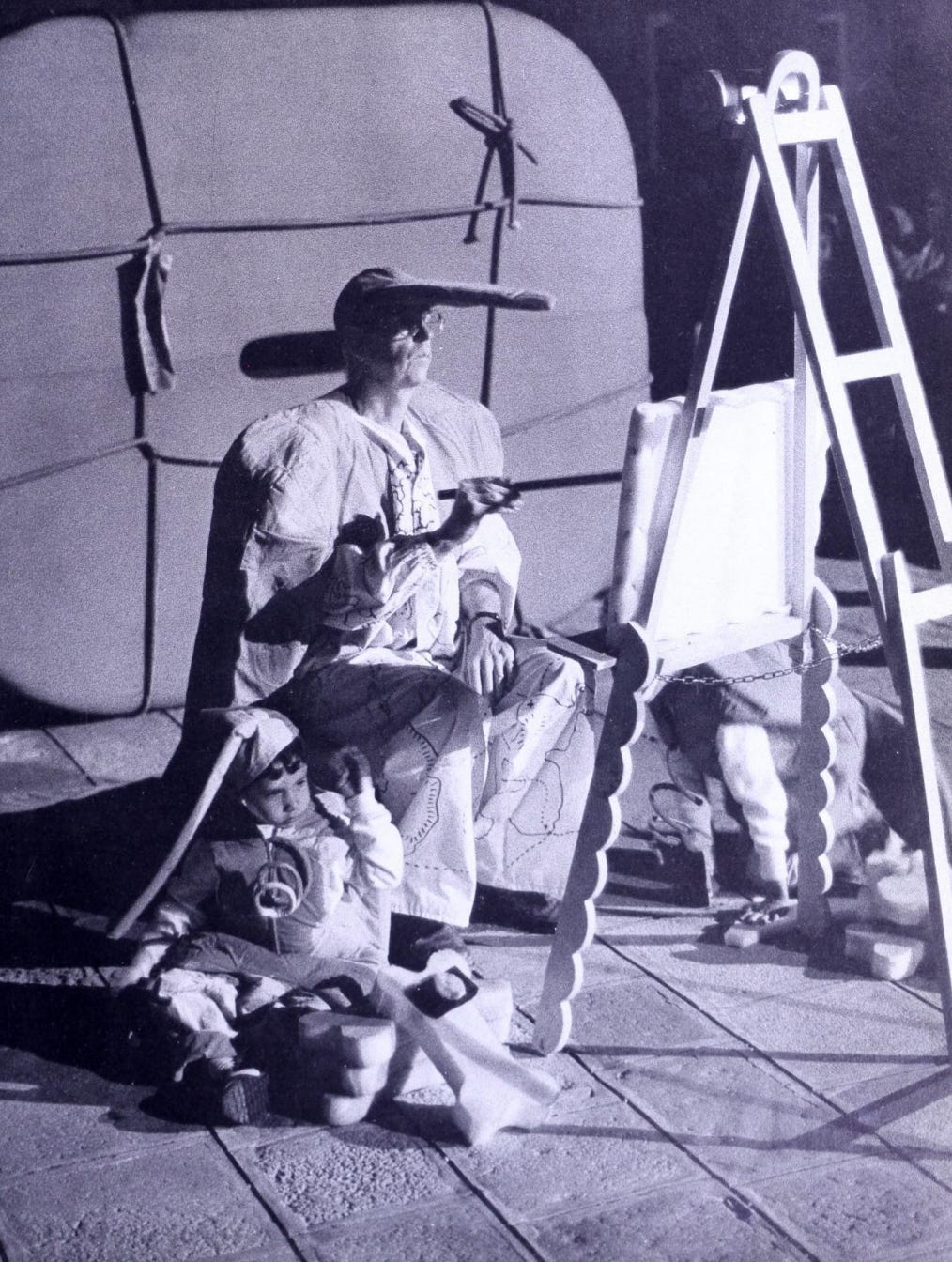
Writing at the time, The New York Times art critic Roberta Smith was not seduced. She felt that the forms and performance was largely a disconnected spectacle, describing it as “a hermetic, and very expensive amusement enjoyed most completely by its many participants.” However she also admitted that the real value of Il Corso del Coltello might not be visible in the event itself, or in its remnants, but only later, in what it unlocked. If that’s true, then its legacy is less an artwork than a permission slip: to make in public, across disciplines, with uncertainty built in. To treat a city as a living set, and to let chaos be the medium that reconnects objects, bodies, and time.
Maybe that’s what deliberate chaos does at its best, it breaks the spell of the comfort zone. It reopens the future by interrupting the loop of the familiar. In Sarajevo, that interruption looked like a spinning wooden circle and a cup of coffee served to strangers on a stage. In Venice, it looked like a knife, scaled up until you couldn’t ignore it, used not as threat but as tool: to carve new meanings out of old surfaces.
In an era that rewards frictionless aesthetics and isolated consumption, both works insist on a harder, better premise: that art is not content.
It is a practice of being together.
So the question is: will we keep choosing low-stakes content gazing, or are we willing to show up and make live, messy work together?
REFERENCES
Celant, Germano, ed. Il corso del coltello = The course of the knife: Claes Oldenburg, Coosje van Bruggen, Frank O. Gehry. New York: Rizzoli International Publications, 1987.
Klein, Naomi. “Surrealism Against Fascism.” Equator, November 26, 2025.
Smith, Roberta. “Art: Oldenburg’s Works as Props for ‘Il Corso’.” The New York Times, January 9, 1987.
Touhami, Ramdane. “Towards an Esthetic Deglobalization.” Ramdane Touhami (website), accessed January 14, 2026.
Van Bruggen, Coosje, and Frank O. Gehry. “Waiting for Dr. Coltello: A Project for Artforum.” Artforum (print), September 1984. Accessed January 14, 2026.